
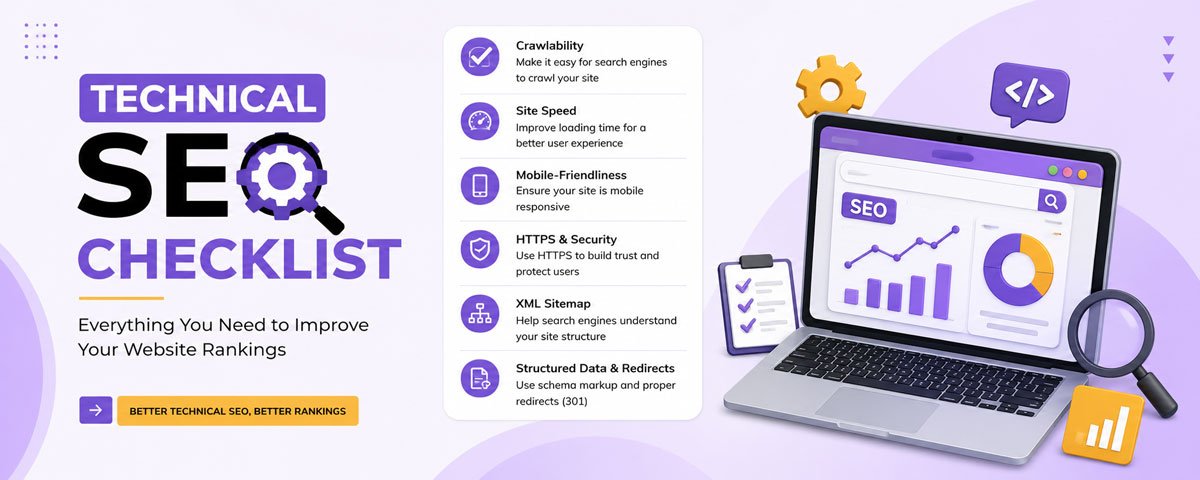
Technical SEO Checklist: Everything You Need to Improve Your Website Rankings is essential for businesses that want consistent organic traffic and higher Google rankings. Publishing high-quality content alone is no longer enough. Search engines also evaluate how well a website performs behind the scenes before deciding where it should rank.
Technical SEO improves the foundation of a website. It helps search engines crawl pages, understand content, and index important URLs without unnecessary obstacles. As a result, a technically optimized website has a better chance of appearing in search results.
Moreover, technical improvements create a better experience for visitors. Faster loading pages, secure browsing, clean navigation, and mobile-friendly layouts encourage users to stay longer and explore additional content. Consequently, positive user behaviour can support stronger search performance over time.
Businesses aiming to improve website speed, user experience, and organic visibility can explore professional website development services that focus on building SEO-friendly websites with modern technical standards.
This comprehensive Technical SEO Checklist covers the most important optimizations for 2026. It explains how to improve crawling, indexing, page speed, website security, and overall technical health to achieve sustainable search rankings.
Why Technical SEO Matters in 2026
Search engine algorithms continue to evolve every year. Today, Google evaluates much more than keywords and content quality. It also examines website performance, mobile usability, security, and technical reliability before determining rankings.
Therefore, even informative content may struggle to rank if technical issues prevent search engines from accessing or understanding important pages. On the other hand, a technically optimized website allows every SEO effort to perform more effectively.
Technical SEO also strengthens other digital marketing activities. For example, content marketing, link building, and on-page optimization generate better results when the website has a strong technical foundation.
Google considers several technical ranking signals, including:
- Crawlability – Search engines should access every important page without restrictions.
- Indexability – Valuable pages should appear in Google’s search index.
- Website Performance – Fast loading speeds improve both rankings and user experience.
- Mobile Friendliness – Every page should function properly across all devices.
- Website Security – HTTPS helps protect visitors and builds trust.
Improving these areas creates a stronger technical foundation that supports long-term organic growth.
1. Ensure Search Engines Can Crawl Your Website
Website crawling is the first step in the ranking process. If search engines cannot access important pages, those pages cannot appear in search results. Therefore, regular crawl audits are essential for maintaining strong website visibility.
Begin by reviewing the technical settings that control crawling. Even a small configuration mistake can prevent Google from discovering valuable content.
Complete the following checks regularly:
- Review the robots.txt file for blocked pages.
- Create and maintain an updated XML sitemap.
- Submit the sitemap through Google Search Console.
- Monitor crawl errors and server response issues.
- Repair broken internal links.
- Connect important pages using logical internal links.
In addition, check for orphan pages that have no internal links pointing toward them. Search engines often struggle to discover these pages, which limits their ability to rank. A clear website structure improves crawling while making navigation easier for visitors.
2. Resolve Website Indexing Issues
Crawling and indexing are different processes. Search engines may crawl a page but still decide not to include it in search results. Consequently, important content may remain invisible to potential visitors.
Regular indexing audits help identify technical issues before they affect rankings.
Common indexing problems include:
- Pages containing the noindex directive.
- Duplicate content without canonical tags.
- Soft 404 pages.
- Incorrect redirect configurations.
- Parameter-based URLs creating duplicate pages.
- Pages excluded because of crawl anomalies.
Finally, use the URL Inspection tool in Google Search Console to confirm whether Google has indexed important pages correctly. Resolving indexing issues allows valuable content to appear in search results more consistently.
3. Improve Website Speed and Core Web Vitals
Website speed directly affects both user experience and search rankings. Visitors expect pages to load quickly, and they often leave if a website takes too long to respond. As a result, slow websites usually experience higher bounce rates and lower conversions.
Google also evaluates page experience through Core Web Vitals. These metrics measure loading performance, visual stability, and responsiveness. Therefore, improving these metrics can strengthen both SEO performance and visitor satisfaction.
Several optimizations can improve website speed significantly:
- Compress images before uploading them.
- Use modern formats such as WebP.
- Enable browser caching.
- Minify HTML, JavaScript, and CSS files.
- Reduce unnecessary third-party scripts.
- Choose reliable and fast web hosting.
- Use a Content Delivery Network (CDN) for global audiences.
In addition, test website performance regularly using Google PageSpeed Insights. The report highlights opportunities to improve loading speed, Core Web Vitals, and overall website performance.
Businesses planning to improve website speed alongside technical SEO can explore professional website development services that focus on faster, SEO-friendly websites.
4. Optimize Every Page for Mobile Users
Google follows mobile-first indexing. This means the mobile version of a website plays the biggest role in determining search rankings. Consequently, a poor mobile experience can reduce organic visibility even when the desktop version performs well.
Every page should provide a smooth browsing experience across smartphones and tablets. Furthermore, responsive websites improve usability while reducing bounce rates.
Review these mobile optimization factors:
- Keep text readable without zooming.
- Create buttons that are easy to tap.
- Design simple and user-friendly navigation.
- Make forms easy to complete on smaller screens.
- Avoid intrusive pop-ups that block important content.
- Use responsive layouts for every screen size.
- Ensure images and videos display correctly on mobile devices.
After making updates, test the website on different devices to confirm that every page remains accessible and easy to navigate.
5. Secure Your Website with HTTPS
Website security protects visitor information while increasing trust. Google also uses HTTPS as a ranking signal because secure websites provide a safer browsing experience.
If visitors notice a “Not Secure” warning, they may leave the website before viewing any content. Therefore, securing every page should become a priority.
Complete these security checks:
- Install a valid SSL certificate.
- Redirect every HTTP page to HTTPS using 301 redirects.
- Update internal links to the HTTPS version.
- Resolve mixed-content warnings.
- Renew SSL certificates before they expire.
Moreover, review website security after every major update to ensure the secure connection continues working correctly.
6. Build a Clear Website Structure
A well-organized website helps both visitors and search engines understand how pages connect with one another. In addition, logical navigation allows search engines to crawl important pages more efficiently.
Simple website architecture also distributes authority through internal links. Consequently, important pages receive stronger ranking signals while users find information more easily.
A technically optimized website structure should include:
- Short and descriptive URLs.
- Logical navigation menus.
- Breadcrumb navigation where appropriate.
- Organized categories and subcategories.
- Relevant internal links between related pages.
- Important pages accessible within three clicks from the homepage.
Finally, review the website structure regularly as new pages are published. Maintaining a clean hierarchy supports better crawling, indexing, and user experience.
Learn more about Sirmedia’s experience in building SEO-focused websites by visiting the About Us page.
7. Implement Structured Data (Schema Markup)
Structured data helps search engines understand the purpose of a webpage more accurately. Instead of interpreting only the visible content, Google can recognize whether a page is an article, service page, FAQ, product, or local business. As a result, the page becomes eligible for enhanced search features.
Moreover, schema markup can improve click-through rates by generating rich results such as FAQs, breadcrumbs, reviews, and business information. Although schema does not directly increase rankings, it improves how pages appear in search results.
The most useful schema types include:
- Article Schema for blog posts.
- FAQ Schema for frequently asked questions.
- Organization Schema for company websites.
- Service Schema for service pages.
- LocalBusiness Schema for location-based businesses.
- Breadcrumb Schema for better navigation.
Before publishing, validate structured data using Google Rich Results Test. This tool identifies markup errors and helps ensure search engines can read the structured data correctly.
8. Fix Broken Links and Redirect Problems
Broken links interrupt website navigation and create a poor user experience. They also prevent search engines from crawling important pages efficiently. Therefore, regular link audits should become part of every technical SEO strategy.
Redirect issues can create similar problems. For example, redirect chains increase loading time and waste crawl budget. Instead, redirect visitors directly to the final destination.
Review these areas regularly:
- Repair internal links that return 404 errors.
- Replace outdated URLs with active pages.
- Remove unnecessary redirect chains.
- Use permanent 301 redirects when pages move.
- Update internal links after changing URLs.
- Review external links to ensure they remain active.
Furthermore, website crawlers such as Screaming Frog SEO Spider help identify technical issues before they affect search performance.
9. Maintain an Optimized XML Sitemap
An XML sitemap guides search engines toward important pages. Although search engines discover pages through internal links, an updated sitemap improves crawling efficiency and helps new content appear faster in search results.
A properly maintained sitemap should:
- Include only indexable pages.
- Exclude redirected URLs.
- Remove duplicate pages.
- Contain accurate canonical URLs.
- Update automatically after publishing new content.
After updating the sitemap, submit it through Google Search Console. Consequently, search engines receive faster notifications whenever important pages change.
10. Remove Duplicate Content
Duplicate content often divides ranking signals across multiple URLs. Instead of strengthening one page, search engines struggle to determine which version deserves higher visibility.
Several technical issues can create duplicate content without notice. Therefore, regular website audits help identify these problems before rankings decline.
Common causes include:
- HTTP and HTTPS versions of the same page.
- WWW and non-WWW website versions.
- Parameter-based URLs.
- Printer-friendly pages.
- Category and tag archives with similar content.
- Repeated product descriptions across multiple pages.
Canonical tags help search engines identify the preferred version of a page. Likewise, removing duplicate URLs improves crawl efficiency and strengthens organic visibility.
Businesses aiming to improve technical SEO alongside long-term organic growth can explore professional website and SEO solutions designed for sustainable search performance.
11. Monitor Core Web Vitals Consistently
Technical SEO requires continuous monitoring rather than a one-time audit. Website updates, plugin installations, or design changes can affect performance without warning. Therefore, reviewing Core Web Vitals regularly helps identify issues before rankings decline.
Pay close attention to these performance metrics:
- Largest Contentful Paint (LCP) should remain below 2.5 seconds.
- Interaction to Next Paint (INP) should stay below 200 milliseconds.
- Cumulative Layout Shift (CLS) should remain below 0.1.
Finally, review these reports every month using Google PageSpeed Insights and Google Search Console. Regular monitoring supports better website performance, improved user experience, and stronger organic rankings.
7. Implement Structured Data (Schema Markup)
Structured data helps search engines understand the purpose of a webpage more accurately. Instead of interpreting only the visible content, Google can recognize whether a page is an article, service page, FAQ, product, or local business. As a result, the page becomes eligible for enhanced search features.
Moreover, schema markup can improve click-through rates by generating rich results such as FAQs, breadcrumbs, reviews, and business information. Although schema does not directly increase rankings, it improves how pages appear in search results.
The most useful schema types include:
- Article Schema for blog posts.
- FAQ Schema for frequently asked questions.
- Organization Schema for company websites.
- Service Schema for service pages.
- LocalBusiness Schema for location-based businesses.
- Breadcrumb Schema for better navigation.
Before publishing, validate structured data using Google Rich Results Test. This tool identifies markup errors and helps ensure search engines can read the structured data correctly.
8. Fix Broken Links and Redirect Problems
Broken links interrupt website navigation and create a poor user experience. They also prevent search engines from crawling important pages efficiently. Therefore, regular link audits should become part of every technical SEO strategy.
Redirect issues can create similar problems. For example, redirect chains increase loading time and waste crawl budget. Instead, redirect visitors directly to the final destination.
Review these areas regularly:
- Repair internal links that return 404 errors.
- Replace outdated URLs with active pages.
- Remove unnecessary redirect chains.
- Use permanent 301 redirects when pages move.
- Update internal links after changing URLs.
- Review external links to ensure they remain active.
Furthermore, website crawlers such as Screaming Frog SEO Spider help identify technical issues before they affect search performance.
9. Maintain an Optimized XML Sitemap
An XML sitemap guides search engines toward important pages. Although search engines discover pages through internal links, an updated sitemap improves crawling efficiency and helps new content appear faster in search results.
A properly maintained sitemap should:
- Include only indexable pages.
- Exclude redirected URLs.
- Remove duplicate pages.
- Contain accurate canonical URLs.
- Update automatically after publishing new content.
After updating the sitemap, submit it through Google Search Console. Consequently, search engines receive faster notifications whenever important pages change.
10. Remove Duplicate Content
Duplicate content often divides ranking signals across multiple URLs. Instead of strengthening one page, search engines struggle to determine which version deserves higher visibility.
Several technical issues can create duplicate content without notice. Therefore, regular website audits help identify these problems before rankings decline.
Common causes include:
- HTTP and HTTPS versions of the same page.
- WWW and non-WWW website versions.
- Parameter-based URLs.
- Printer-friendly pages.
- Category and tag archives with similar content.
- Repeated product descriptions across multiple pages.
Canonical tags help search engines identify the preferred version of a page. Likewise, removing duplicate URLs improves crawl efficiency and strengthens organic visibility.
Businesses aiming to improve technical SEO alongside long-term organic growth can explore professional website and SEO solutions designed for sustainable search performance.
11. Monitor Core Web Vitals Consistently
Technical SEO requires continuous monitoring rather than a one-time audit. Website updates, plugin installations, or design changes can affect performance without warning. Therefore, reviewing Core Web Vitals regularly helps identify issues before rankings decline.
Pay close attention to these performance metrics:
- Largest Contentful Paint (LCP) should remain below 2.5 seconds.
- Interaction to Next Paint (INP) should stay below 200 milliseconds.
- Cumulative Layout Shift (CLS) should remain below 0.1.
Finally, review these reports every month using Google PageSpeed Insights and Google Search Console. Regular monitoring supports better website performance, improved user experience, and stronger organic rankings.
12. Optimize International SEO (If Your Business Serves Multiple Regions)
Businesses targeting customers across different countries or languages should implement international SEO correctly. Otherwise, search engines may display the wrong version of a page or split ranking signals between similar URLs.
Using the correct international SEO setup helps search engines deliver the most relevant content to each audience. Consequently, visitors receive a better browsing experience while websites improve their visibility in regional search results.
Follow these international SEO best practices:
- Implement hreflang tags correctly.
- Create separate URLs for different languages or regions.
- Maintain accurate translations across every version.
- Avoid automatic location-based redirects.
- Keep navigation consistent on every language version.
Furthermore, review international settings regularly to ensure every regional page remains accessible and correctly indexed.
Common Technical SEO Mistakes That Lower Rankings
Many websites lose valuable organic traffic because technical issues remain unnoticed for long periods. Fortunately, most of these problems are easy to fix once identified.
Avoid these common technical SEO mistakes:
- Blocking important pages in the robots.txt file.
- Ignoring crawl and indexing errors.
- Leaving broken internal links unresolved.
- Publishing duplicate pages without canonical tags.
- Using duplicate title tags and meta descriptions.
- Ignoring Core Web Vitals.
- Allowing slow page loading speeds.
- Neglecting mobile usability.
- Creating redirect chains and loops.
- Skipping structured data implementation.
Regular technical audits help identify these issues early. As a result, websites remain healthy, crawlable, and easier for search engines to understand.
Technical SEO Checklist
Review this checklist regularly to maintain a technically optimized website.
- Allow search engines to crawl important pages.
- Submit and update the XML sitemap.
- Fix crawl and indexing issues promptly.
- Improve Core Web Vitals and page speed.
- Optimize every page for mobile devices.
- Secure the website with HTTPS.
- Maintain a clean website structure.
- Implement relevant schema markup.
- Repair broken links and redirects.
- Remove duplicate content.
- Monitor technical performance regularly.
- Audit the website after major updates.
Recommended Technical SEO Tools
| Tool | Purpose |
|---|---|
| Google Search Console | Monitor crawling, indexing, and website performance. |
| Google PageSpeed Insights | Measure website speed and Core Web Vitals. |
| Google Rich Results Test | Validate structured data implementation. |
| Google Analytics 4 | Analyze website traffic and visitor behaviour. |
| Screaming Frog SEO Spider | Identify crawl errors and technical SEO issues. |
| GTmetrix | Evaluate website loading performance. |
| Bing Webmaster Tools | Monitor website health on Bing Search. |
Frequently Asked Questions
What is technical SEO?
Technical SEO improves the technical elements of a website so search engines can crawl, index, and understand pages more efficiently. It focuses on website performance, security, mobile usability, structured data, and site architecture.
How often should a technical SEO audit be performed?
A complete technical SEO audit should be carried out every three to six months. However, large websites and eCommerce stores should review technical issues more frequently.
Does page speed affect Google rankings?
Yes. Google considers page speed and Core Web Vitals as ranking signals. Therefore, faster websites often provide a better user experience and stronger organic visibility.
Why is an XML sitemap important?
An XML sitemap helps search engines discover important pages more efficiently. In addition, it supports faster crawling and indexing of newly published content.
What causes indexing issues?
Indexing problems usually occur because of noindex directives, crawl errors, duplicate content, incorrect canonical tags, or blocked pages.
Is HTTPS necessary for SEO?
Yes. HTTPS secures visitor data, improves trust, and acts as a confirmed Google ranking signal.
Which tool is best for checking technical SEO?
Google Search Console remains one of the most reliable tools for monitoring crawl errors, indexing issues, website health, and search performance.
Can technical SEO improve organic traffic?
Yes. A technically optimized website helps search engines understand content more effectively. Consequently, improved crawling, faster loading speeds, and better user experience often lead to stronger organic visibility.
Final Thoughts
Technical SEO forms the foundation of every successful SEO strategy. Without proper crawling, indexing, website speed, and security, even high-quality content may struggle to achieve consistent rankings. Therefore, regular technical improvements should become part of every website maintenance plan.
Moreover, technical SEO is not a one-time task. Search engine algorithms continue to evolve, and websites also change over time. Regular audits help identify issues early while protecting long-term organic performance.
Businesses looking to strengthen their website’s technical foundation can explore professional website development and technical SEO services designed to improve performance, user experience, and search visibility.
Learn more about Sirmedia’s experience by visiting the About Us page. Businesses ready to discuss a project can submit their requirements through the Enquiry page. Professionals interested in joining the team can also explore current opportunities on the Careers page.
Leave a Reply