
Local SEO Checklist for Small Businesses has become more important than ever for businesses that depend on nearby customers. Most people no longer search through directories or ask around for recommendations. Instead, they open Google, search for a nearby service, and usually contact one of the first businesses shown on Google Maps.
Appearing in those top local results doesn’t happen by chance. Google ranks businesses based on several trust signals, including the quality of a business profile, customer reviews, website relevance, and local authority. A business that regularly updates its online presence often earns better visibility than competitors that ignore these ranking factors.
Local SEO isn’t only about adding a location name to a website. It involves creating a trustworthy online presence that helps Google understand where a business operates and why it deserves a higher position in local search results.
Businesses looking to improve their website alongside local search performance can explore professional web development services designed to improve website speed, user experience, and search visibility.
This practical checklist explains the most effective Local SEO strategies for 2026, helping small businesses improve Google Maps rankings, attract more local customers, and generate consistent enquiries.
Why Local SEO Matters in 2026
Local search continues to influence buying decisions across almost every industry. Whether someone needs a restaurant, salon, clinic, repair service, or retail store, Google Maps usually becomes the starting point.
Searches with local intent often lead to quick decisions because people are already looking for a nearby solution. A complete and trustworthy online presence increases the chances of receiving phone calls, direction requests, website visits, and enquiries.
Google evaluates several factors before deciding which businesses appear in the Local Pack. The three most important signals include:
- Relevance – How closely a business matches the search query.
- Distance – How close the business is to the searcher’s location.
- Prominence – How well-known and trusted the business appears online.
Although distance cannot always be controlled, relevance and prominence can improve significantly through a well-planned Local SEO strategy.
1. Claim and Complete Your Google Business Profile
A Google Business Profile is the foundation of every successful Local SEO campaign. An incomplete profile limits visibility, while a fully optimized listing gives Google more confidence when displaying local search results.
Start by claiming and verifying the business profile. Then complete every available section with accurate information instead of leaving important fields blank.
- Use the official business name exactly as it appears offline.
- Select the most relevant primary business category.
- Add suitable secondary categories where appropriate.
- Include the correct business address, phone number, and website.
- Set accurate business hours and holiday timings.
- Write a clear business description using natural local keywords.
- Add available services, products, and business attributes.
A complete profile builds trust with both Google and potential customers. Keyword stuffing or adding unnecessary location names to the business title can violate Google’s guidelines and reduce long-term visibility.
Google’s official Google Business Profile Help Center provides recommendations for maintaining an accurate and compliant business listing.
2. Keep Business Information Consistent Across Every Platform
Consistency plays a major role in local search rankings. Business information should remain identical everywhere it appears online.
The business name, address, and phone number—commonly called NAP—should match across the website, Google Business Profile, social media accounts, and trusted business directories.
Even small differences can create confusion for search engines. For example, using different phone numbers or slightly different business names across multiple platforms may reduce trust signals over time.
Review business information regularly on directories such as Google, Justdial, IndiaMART, Sulekha, Facebook Business, and other industry-specific listings. Accurate information strengthens local authority and improves search consistency.
A professionally developed website also helps maintain consistent business information while supporting stronger local rankings. Learn more about Sirmedia’s experience in building SEO-friendly business websites.
3. Build a Steady Flow of Genuine Customer Reviews
Reviews influence both search rankings and customer decisions. Before contacting a business, most people spend a few minutes reading recent reviews to understand the quality of service. A business with authentic, detailed feedback usually earns more trust than one with only a handful of outdated ratings.
Google also considers review quality, quantity, and freshness when ranking local businesses. Consistent reviews signal that a business remains active and continues serving customers.
- Request reviews after a successful purchase or completed service.
- Share a direct review link through email or WhatsApp.
- Respond politely to every review, including negative feedback.
- Avoid offering incentives or purchasing fake reviews.
- Encourage customers to describe their actual experience.
Thoughtful replies show that customer feedback matters. A professional response can strengthen credibility even when a review highlights a problem.
4. Create Accurate Local Citations
Local citations are online mentions of a business across trusted websites and directories. These listings help search engines verify business information while strengthening local authority.
Quality always delivers better results than quantity. A few accurate citations on reputable websites provide more value than dozens of low-quality directory listings.
Popular citation sources include:
- Google Business Profile
- Justdial
- IndiaMART
- Sulekha
- Bing Places
- Facebook Business
- Industry-specific business directories
Before submitting a listing, double-check that the business name, address, phone number, website, and business category match the official website exactly.
5. Optimize Every Important Website Page for Local Search
A Google Business Profile helps people discover a business, but the website still plays a major role in local rankings. Google compares website content with the business profile to determine whether both provide accurate and relevant information.
Each service page should clearly explain what the business offers and where those services are available. Instead of repeating the city name throughout the page, mention locations naturally where they make sense.
For businesses serving multiple cities, dedicated location pages usually perform better than placing every city on a single page.
Strong local landing pages should include:
- Unique page titles with location-based keywords.
- Helpful service descriptions.
- Business contact information.
- Location-specific FAQs.
- Embedded Google Maps where appropriate.
- Internal links to related services.
Website performance also affects local rankings. A fast-loading, mobile-friendly website improves user experience and helps visitors find information without frustration. Businesses planning to improve website performance can explore custom website solutions built with SEO best practices in mind.
6. Target Local Keywords That Match Real Searches
Many businesses focus only on broad keywords and overlook the phrases that local customers actually search. Local intent keywords usually have stronger conversion potential because they reflect immediate buying interest.
Instead of targeting generic phrases, focus on searches that combine a service with a city, neighbourhood, or nearby landmark.
| Broad Keyword | Local Search Example |
|---|---|
| Digital Marketing Agency | Digital Marketing Agency in Ahmedabad |
| Dentist | Best Dentist Near SG Highway |
| Electrician | 24 Hour Electrician in Ahmedabad |
| Salon | Hair Salon Near Me |
| AC Repair | AC Repair Service in Ahmedabad |
Keyword research tools such as Google Keyword Planner, Google Search Console, and Google Trends help identify local search opportunities based on actual user behaviour.
Adding these keywords naturally across headings, page content, image ALT text, and meta descriptions makes a page more relevant without affecting readability.
7. Upload Fresh Photos and Videos Regularly
Visual content does more than improve the appearance of a Google Business Profile. It helps potential customers understand what a business offers before they make contact. Businesses with updated photos often receive more profile views, website visits, and direction requests than listings with little or no visual content.
Instead of relying on stock images, upload original photos that reflect the business accurately. Genuine images build trust and create a stronger first impression.
Consider adding:
- Exterior and interior business photos.
- Products and completed projects.
- Team members at work.
- Office, showroom, or workspace images.
- Short videos highlighting services.
- Photos from recent events or promotions.
Refreshing photos every few weeks signals that the business remains active. Regular updates also encourage potential customers to interact with the listing.
8. Publish Google Business Profile Updates
Many business owners overlook Google Business Profile Posts, even though they offer another opportunity to improve visibility. These updates appear directly on the business profile and provide useful information for potential customers.
Posting regularly keeps the profile active while giving visitors a reason to engage with the business.
Useful post ideas include:
- New product launches.
- Seasonal offers and discounts.
- Business announcements.
- Upcoming events.
- Customer success stories.
- Educational tips related to the industry.
Each update should include clear information, a relevant image, and a simple call to action that encourages visitors to learn more or make contact.
9. Monitor Local SEO Performance
Local SEO requires regular monitoring. Search rankings change frequently, and customer behaviour also evolves throughout the year. Tracking performance makes it easier to identify what works and where improvements are needed.
Important metrics to review include:
- Google Maps rankings.
- Website visits from local searches.
- Phone calls generated through Google Business Profile.
- Direction requests.
- Customer enquiries.
- Keyword rankings.
- Review growth over time.
Reliable tools such as Google Search Console, Google Analytics 4, and Google Business Profile Manager provide valuable insights into local search performance.
Businesses that review performance regularly can identify ranking opportunities before competitors do.
10. Earn Local Backlinks That Build Authority
Backlinks remain one of Google’s strongest ranking signals. When trusted local websites mention or link to a business, search engines treat those links as evidence of credibility and authority.
Focus on earning links naturally instead of purchasing them. High-quality backlinks continue providing SEO value long after they are published.
Effective ways to earn local backlinks include:
- Partner with nearby businesses.
- Sponsor community events.
- Contribute articles to local publications.
- Join local business associations.
- Participate in charity or community initiatives.
- Share original research or industry insights.
Google recommends avoiding manipulative link-building practices because they violate search guidelines and can affect rankings. Google’s Search Spam Policies explain which practices should be avoided.
A strong backlink strategy becomes even more effective when combined with an SEO-friendly website structure, fast page speed, and well-optimized service pages. Businesses seeking long-term organic growth can learn more about the digital marketing approach offered by Sirmedia, where every strategy focuses on sustainable search visibility rather than short-term ranking gains.
Common Local SEO Mistakes That Hurt Google Maps Rankings
Many businesses invest time in Local SEO but still struggle to rank because a few critical mistakes weaken their online presence. Identifying these issues early helps protect search visibility and improve long-term performance.
- Leaving the Google Business Profile incomplete.
- Using different business details across directories.
- Ignoring customer reviews.
- Publishing duplicate location pages.
- Targeting keywords unnaturally.
- Using outdated business information.
- Neglecting mobile website performance.
- Ignoring broken links and technical issues.
- Building low-quality backlinks.
- Updating the business profile only once and never maintaining it.
Correcting these issues creates a stronger foundation for better Google Maps rankings and improved local search visibility.
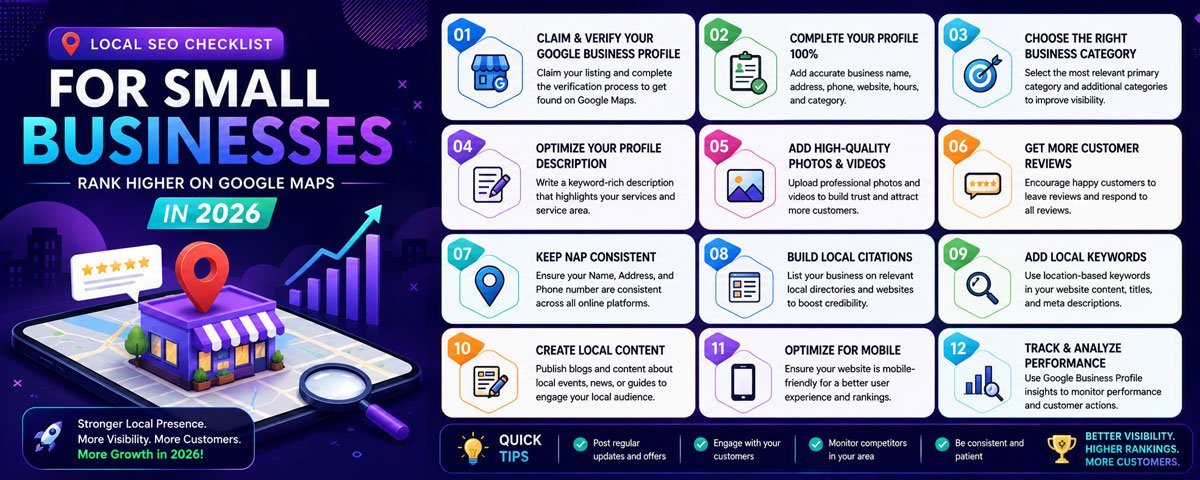
Local SEO Checklist for Small Businesses
Use this checklist before considering a Local SEO campaign complete. Reviewing these points regularly helps maintain strong visibility in Google Maps and local search results.
- Claim and verify the Google Business Profile.
- Keep business name, address, and phone number consistent across every platform.
- Select accurate business categories.
- Write a unique business description with natural local keywords.
- Upload high-quality photos and short videos regularly.
- Collect genuine customer reviews and respond to every review.
- Build citations on trusted business directories.
- Create dedicated location and service pages.
- Optimize website speed and mobile usability.
- Use LocalBusiness schema markup.
- Track rankings, website traffic, and customer enquiries.
- Earn backlinks from trusted local websites.
Recommended Tools for Local SEO
| Tool | Purpose |
|---|---|
| Google Business Profile | Manage business information, reviews, photos, and local visibility. |
| Google Search Console | Monitor keyword rankings, indexing, and website performance. |
| Google Analytics 4 | Measure website traffic, conversions, and visitor behaviour. |
| Google Keyword Planner | Research location-based keywords. |
| Google PageSpeed Insights | Identify website speed improvements. |
| Google Trends | Discover growing local search trends. |
| Google Rich Results Test | Validate structured data and schema markup. |
Frequently Asked Questions
What is Local SEO?
Local SEO improves a business’s visibility in location-based search results. It helps businesses appear in Google Maps and local search listings when customers search for nearby products or services.
How long does Local SEO take to show results?
Most businesses notice measurable improvements within three to six months. The timeline depends on competition, website quality, customer reviews, and the consistency of optimization efforts.
Does a small business need a website for Local SEO?
Yes. A Google Business Profile performs better when supported by a well-optimized website. Service pages, contact information, and locally relevant content strengthen search signals.
How often should a Google Business Profile be updated?
Adding fresh photos, publishing updates, checking business information, and responding to reviews every month helps keep the profile active and trustworthy.
Are customer reviews important for Google Maps rankings?
Yes. Authentic reviews influence both local rankings and customer confidence. Regular reviews with thoughtful responses create stronger trust signals.
What are local citations?
Local citations are online mentions of a business’s name, address, phone number, and website across trusted directories and business listing platforms.
Can Local SEO work without paid advertising?
Yes. A consistent Local SEO strategy can generate long-term visibility and qualified leads without relying on paid ads.
Why is mobile optimization important for Local SEO?
Most local searches happen on smartphones. A fast, mobile-friendly website improves user experience and increases the likelihood of converting visitors into customers.
Final Thoughts
Ranking higher on Google Maps in 2026 requires more than creating a business listing. Consistent business information, genuine customer reviews, high-quality website content, local backlinks, and regular profile updates all contribute to stronger local search visibility.
Businesses that treat Local SEO as an ongoing process often achieve better long-term results than those making occasional updates. Small improvements made consistently can outperform large one-time changes.
A professionally optimized website also plays an essential role in local rankings. Businesses planning to improve website performance, technical SEO, and search visibility can explore website development services tailored for modern businesses.
Additional information about the team, experience, and digital expertise is available on the About Us page. Businesses ready to discuss a Local SEO strategy can submit project requirements through the Enquiry page. Professionals interested in building digital solutions and SEO-driven websites can also explore current opportunities on the Careers page.
Leave a Reply