
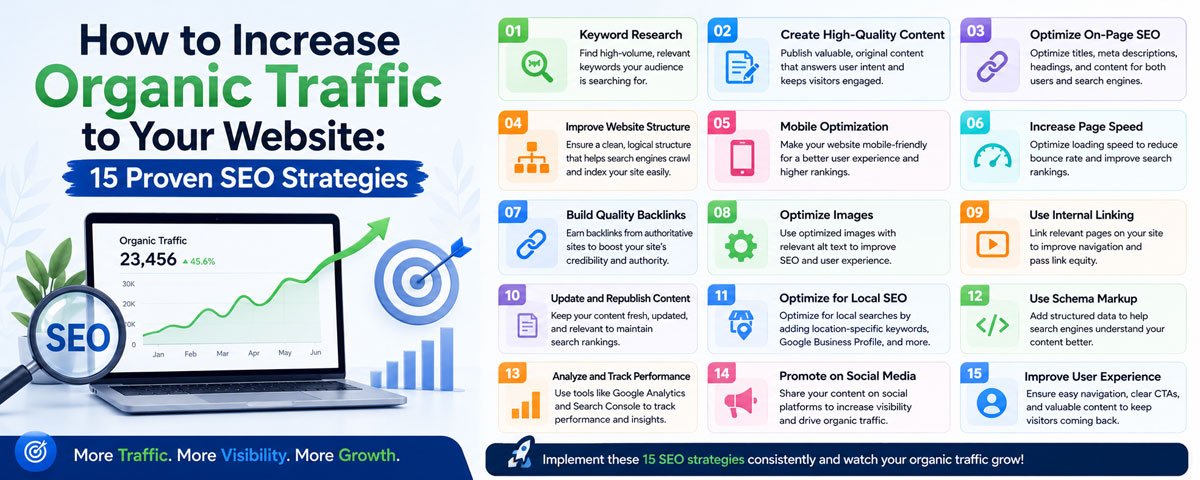
Learning how to increase organic traffic to your website is one of the smartest ways to achieve long-term online growth. Unlike paid advertising, organic traffic comes from people who discover a website through unpaid search engine results. These visitors are actively searching for information, products, or services, making them more likely to engage with content and become customers.
A successful SEO strategy combines keyword research, valuable content, technical optimization, and a strong user experience. Although SEO requires consistency, it delivers sustainable results that continue driving qualified traffic over time. Businesses looking to build a fast, search-friendly website can explore professional web development services designed to improve website performance and search visibility.
This guide explains 15 proven SEO strategies that help improve search rankings, increase organic traffic, and build long-term online visibility.
What Is Organic Traffic?
Organic traffic refers to visitors who arrive at a website through unpaid search engine results. When someone searches on Google or another search engine and clicks a non-sponsored result, that visit counts as organic traffic.
For example, if a page ranks for the search term “how to increase organic traffic to your website”, every visitor who clicks that listing contributes to organic traffic.
Unlike paid campaigns, organic traffic can continue growing long after content is published, making SEO one of the most cost-effective digital marketing strategies.
Why Is Organic Traffic Important?
Organic visitors usually have clear search intent. Since they are already looking for relevant information or solutions, they often spend more time on a website and are more likely to convert.
- Brings highly targeted visitors.
- Builds long-term search visibility.
- Reduces dependence on paid advertising.
- Strengthens brand credibility.
- Improves return on marketing investment.
- Supports sustainable business growth.
Websites that consistently invest in SEO often achieve stable rankings, qualified leads, and continuous traffic without increasing advertising costs.
How to Increase Organic Traffic to Your Website
The best way to increase organic traffic is by combining quality content, keyword research, technical SEO, on-page optimization, and authoritative backlinks. Search engines reward websites that provide useful information while delivering an excellent user experience.
The following strategies explain how to improve website visibility and attract more qualified visitors from search engines.
1. Conduct Comprehensive Keyword Research
Every successful SEO campaign begins with keyword research. Choosing the right search terms helps create content that matches what people are actively searching for online.
Focus on keywords that offer:
- Strong monthly search volume.
- Realistic ranking opportunities.
- Clear search intent.
- High relevance to the topic.
Long-tail keywords often perform better because they target specific searches with lower competition.
Examples:
- How to increase organic traffic to your website
- Best SEO strategies for beginners
- Ways to improve Google rankings
- Increase website traffic organically
Reliable keyword research tools include
Google Keyword Planner,
Google Search Console, Ahrefs, Semrush, and Ubersuggest.
2. Create High-Quality Content That Solves Real Problems
Helpful content remains one of Google’s strongest ranking signals. Instead of writing only for search engines, focus on answering real questions and providing practical solutions.
High-quality content should:
- Provide accurate and updated information.
- Answer search queries clearly.
- Include practical examples.
- Use short, readable paragraphs.
- Deliver unique value.
Publishing useful articles consistently builds authority and encourages visitors to return. Businesses looking to strengthen their digital presence can also learn more about Sirmedia and its experience in website development and digital marketing.
3. Optimize Every Page for On-Page SEO
On-page SEO helps search engines understand page content while improving the visitor experience. Every important page should follow SEO best practices.
An optimized page should include:
- An SEO-friendly title tag.
- A compelling meta description.
- Proper heading hierarchy (H1, H2, and H3).
- A clean, keyword-friendly URL.
- Relevant internal links.
- Descriptive image ALT text.
- Natural keyword placement.
Avoid keyword stuffing. Instead, use the primary keyword naturally throughout the content while keeping the writing easy to read.
4. Improve Website Speed and Performance
Website speed directly affects both search rankings and user experience. Slow-loading pages increase bounce rates and reduce engagement, making performance optimization essential.
Simple ways to improve page speed include:
- Compress large images.
- Enable browser caching.
- Minify CSS and JavaScript files.
- Choose reliable hosting.
- Remove unnecessary plugins.
- Use a Content Delivery Network (CDN).
Website speed can be tested using Google PageSpeed Insights. A faster website improves user satisfaction and creates a stronger foundation for long-term SEO success.
5. Make Your Website Mobile-Friendly
Most searches now happen on mobile devices. Google also follows mobile-first indexing, meaning it primarily evaluates the mobile version of a website before deciding where it should rank. A website that performs well on smartphones usually delivers a better experience for visitors and has a stronger chance of ranking higher.
To improve mobile usability:
- Choose a responsive website design.
- Improve page loading speed on mobile devices.
- Use readable font sizes.
- Make buttons large enough to tap easily.
- Keep navigation simple and organized.
- Avoid intrusive pop-ups that block important content.
A responsive website improves user engagement and supports better SEO performance. Businesses planning a modern, mobile-friendly website can explore custom web development solutions built for speed, usability, and search engine performance.
6. Match Search Intent Before Writing Content
One of the biggest reasons pages fail to rank is that they do not satisfy search intent. Search intent explains why someone performs a search. Google rewards pages that provide the most relevant answer to that query.
| Search Intent | Purpose | Example |
|---|---|---|
| Informational | Learn about a topic | What is SEO? |
| Navigational | Find a specific website | Google Search Console Login |
| Commercial | Compare products or services | Best SEO tools |
| Transactional | Ready to purchase | Hire an SEO agency |
Every article should answer the reader’s question clearly. Content that fully satisfies search intent usually performs better in search results and keeps visitors engaged for longer.
7. Publish Fresh Content Consistently
SEO is an ongoing process. Websites that publish helpful and updated content regularly often gain more visibility than websites that rarely add new information.
A content calendar helps maintain consistency while covering topics that people actively search for.
Popular content formats include:
- How-to guides
- Industry updates
- Case studies
- Expert tips
- Comparison articles
- Frequently asked questions
- Comprehensive guides
Quality always matters more than quantity. A detailed, well-researched article often generates more organic traffic than several short posts with little value.
Creating content around SEO, websites, and digital marketing also strengthens topical authority. Additional insights about the company behind these services are available on the About Sirmedia page.
8. Build High-Quality Backlinks
Backlinks remain one of the strongest ranking factors in SEO. When trusted websites link to valuable content, search engines treat those links as signals of authority and credibility.
However, quality matters far more than quantity. A handful of links from reputable websites provides greater value than hundreds of low-quality backlinks.
Effective ways to earn quality backlinks include:
- Write guest articles for reputable websites.
- Publish original research and industry data.
- Create in-depth guides that others reference.
- Build relationships with bloggers and industry professionals.
- Promote valuable content through email and social media.
Avoid buying backlinks or participating in link schemes because these practices violate Google’s spam policies and can reduce search visibility.
Strong SEO combines valuable content, technical optimization, ethical link building, and continuous improvement. Organizations looking for professional website and SEO support can submit an enquiry through the Sirmedia contact page to discuss project requirements.
9. Strengthen Your Internal Linking Strategy
Internal linking is one of the most effective ways to increase organic traffic to your website. It helps search engines discover important pages while guiding visitors toward related content that answers additional questions.
A well-planned internal linking strategy can:
- Improve website navigation.
- Help search engines crawl pages more efficiently.
- Distribute authority across important pages.
- Increase average session duration.
- Reduce bounce rates.
Every new article should connect naturally with relevant blog posts, service pages, or resource pages. Descriptive anchor text performs better than generic phrases because it gives users and search engines more context.
10. Update and Refresh Existing Content
Publishing new content is important, but updating older pages can deliver equally impressive SEO results. Search engines prefer content that stays accurate, relevant, and useful over time.
Regular content updates should include:
- Replacing outdated facts and statistics.
- Adding newly discovered keywords.
- Improving readability.
- Expanding thin sections with useful information.
- Fixing broken links.
- Including recent examples where appropriate.
Fresh content signals that a website remains active and trustworthy, which can help maintain or improve search rankings.
11. Optimize Images for Better SEO
Images improve engagement, but they should also support SEO. Proper image optimization helps pages load faster, improves accessibility, and increases the chance of appearing in image search results.
Follow these image optimization best practices:
- Compress images before uploading.
- Use descriptive file names.
- Add keyword-focused ALT text.
- Choose modern formats such as WebP.
- Specify image dimensions to improve loading performance.
Google provides additional image optimization recommendations in its Image SEO documentation. Following these best practices improves both user experience and search visibility.
12. Improve Technical SEO
Technical SEO ensures that search engines can crawl, index, and understand website content without obstacles. Even outstanding content may struggle to rank if technical issues prevent search engines from accessing important pages.
Important technical SEO tasks include:
- Create and submit an XML sitemap.
- Fix crawl errors in Google Search Console.
- Use HTTPS across the entire website.
- Improve Core Web Vitals.
- Remove duplicate content.
- Repair broken links and redirect errors.
- Optimize the robots.txt file.
Regular technical audits help identify issues before they affect rankings or traffic. Businesses seeking SEO-friendly website development can explore Sirmedia’s web solutions, which focus on performance, security, and search engine optimization.
Professionals interested in joining a team that builds high-performing websites can also visit the Careers page to learn about current opportunities.
13. Use Schema Markup to Improve Search Visibility
Schema markup is structured data that helps search engines understand website content more accurately. Although schema does not directly improve rankings, it can increase visibility by making pages eligible for rich results such as FAQs, reviews, and breadcrumbs.
Common schema types include:
- Article Schema
- FAQ Schema
- Breadcrumb Schema
- Organization Schema
- Product Schema
- Review Schema
Adding structured data makes search listings more informative and can improve click-through rates. Google’s Structured Data documentation explains how schema helps search engines understand website content.
14. Prioritize User Experience (UX)
User experience is a key ranking factor because search engines aim to recommend websites that are fast, easy to navigate, and helpful. A clean website encourages visitors to stay longer, explore more pages, and interact with content.
Simple ways to improve user experience include:
- Create a clean and professional layout.
- Use clear navigation menus.
- Write short, easy-to-read paragraphs.
- Add relevant images and graphics.
- Use clear call-to-action buttons.
- Reduce unnecessary pop-ups.
A well-designed website supports better engagement while improving SEO performance. Businesses planning a modern, responsive website can explore professional website development services that focus on speed, usability, and search engine optimization.
15. Monitor SEO Performance Regularly
SEO requires continuous monitoring. Tracking important metrics helps identify successful strategies, discover new opportunities, and resolve issues before rankings decline.
Monitor these SEO metrics regularly:
- Organic traffic growth.
- Keyword rankings.
- Click-through rate (CTR).
- Bounce rate.
- Average engagement time.
- Pages per session.
- Conversions and lead generation.
Tools such as Google Analytics 4 Google Search Console, Ahrefs, and Semrush provide valuable insights for measuring SEO performance and making informed decisions.
Common SEO Mistakes That Reduce Organic Traffic
Even a well-planned SEO strategy can lose effectiveness when common mistakes are overlooked. Avoiding these issues helps maintain steady organic growth.
- Ignoring keyword research.
- Publishing duplicate or thin content.
- Overusing keywords.
- Neglecting mobile optimization.
- Ignoring website speed.
- Building low-quality backlinks.
- Missing internal linking opportunities.
- Leaving outdated content unchanged.
- Overlooking technical SEO issues.
- Failing to monitor website performance.
Regular content improvements, technical maintenance, and quality optimization create a stronger foundation for long-term search visibility.
Essential SEO Tools for Increasing Organic Traffic
| SEO Tool | Purpose |
|---|---|
| Google Search Console | Monitor indexing, search performance, and keyword rankings. |
| Google Analytics 4 | Track organic traffic, user behavior, and conversions. |
| Google Keyword Planner | Discover keyword ideas and monthly search volumes. |
| Ahrefs | Analyze backlinks, competitors, and keywords. |
| Semrush | Perform SEO audits and monitor rankings. |
| Screaming Frog SEO Spider | Identify technical SEO issues. |
| Google PageSpeed Insights | Measure website loading performance. |
SEO Checklist Before Publishing
- Include the primary keyword in the title.
- Place the primary keyword in the introduction.
- Create an SEO-friendly URL.
- Write a unique meta title and meta description.
- Use a proper H1, H2, and H3 heading structure.
- Add relevant internal links.
- Include authoritative outbound links.
- Compress and optimize images.
- Add descriptive ALT text to every image.
- Proofread for spelling and grammar.
- Test the page on mobile devices.
- Improve page loading speed.
- Implement schema markup where appropriate.
Frequently Asked Questions
How long does it take to increase organic traffic?
Most websites begin seeing noticeable SEO improvements within three to six months. The timeline depends on competition, content quality, website authority, and optimization efforts.
What is the fastest way to increase organic traffic?
Optimizing existing pages, targeting low-competition keywords, improving website speed, and publishing valuable content can produce faster SEO improvements.
Do backlinks still matter for SEO?
Yes. High-quality backlinks remain one of Google’s strongest ranking signals. Links from trusted and relevant websites provide significantly more value than low-quality links.
How often should new content be published?
Publishing one or two well-researched articles every week helps maintain consistent growth. Quality should always take priority over quantity.
Can organic traffic increase without paid advertising?
Yes. Consistent SEO, valuable content, technical optimization, and quality link building can generate sustainable organic traffic without relying on paid advertisements.
Conclusion
Understanding how to increase organic traffic to your website is essential for achieving long-term online success. Applying these 15 proven SEO strategies improves search visibility, attracts qualified visitors, and builds lasting authority in search results.
SEO delivers the best results through consistency. Updating content, improving technical performance, earning quality backlinks, and monitoring performance regularly help maintain strong rankings over time.
Businesses looking for expert website development and digital marketing support can explore Sirmedia or discuss project requirements through the enquiry page. Professional SEO and website optimization services can help build a stronger online presence and drive sustainable organic growth.
Leave a Reply